Overwatering kills more plants than drought. Over-fertilizing burns roots and contaminates soil. Manual schedules don’t account for weather, soil type, or plant life stage. The result? Wasted time, wasted money, and frustrated gardeners.
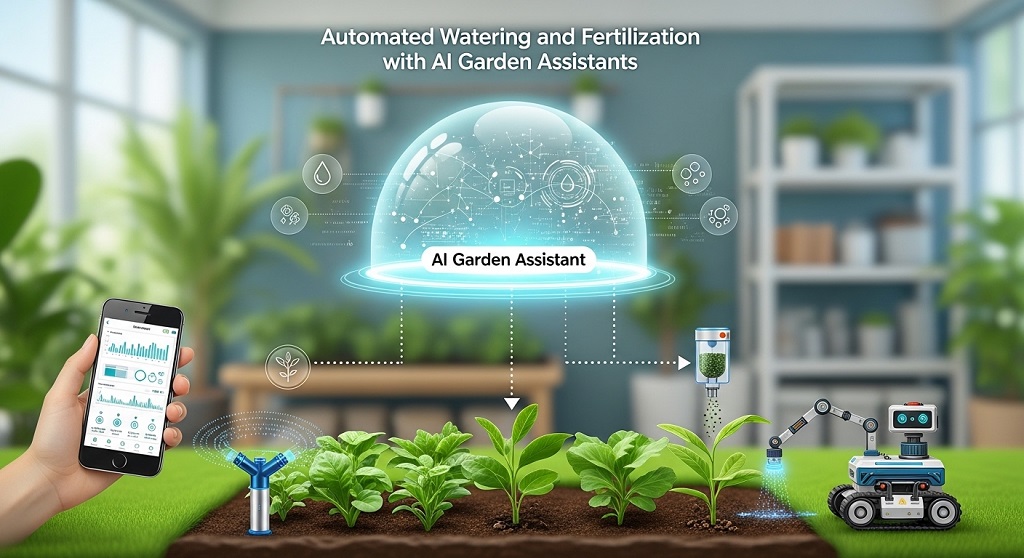
AI garden assistants solve this. These are software and hardware systems that use real-time sensor data, machine learning models, and automated controls to manage irrigation and nutrient delivery — without you having to guess.
In 2026, AI-powered garden automation is no longer a luxury for commercial farms. Home gardeners, urban growers, and small-scale food producers are now using tools like Gardyn, Rachio, Edyn, and GroBot to cut water use by up to 50% and increase plant yields by 30% or more, according to data published by the Smart Irrigation Alliance (2024).
This guide walks you through exactly how to use these tools — what they do, how to set them up, what results to expect, and which platforms are worth your investment in 2026.
What Are AI Garden Assistants and How Do They Work?
AI garden assistants are smart systems that monitor soil, weather, and plant health in real time, then automatically trigger irrigation and fertilization based on data — not guesswork.
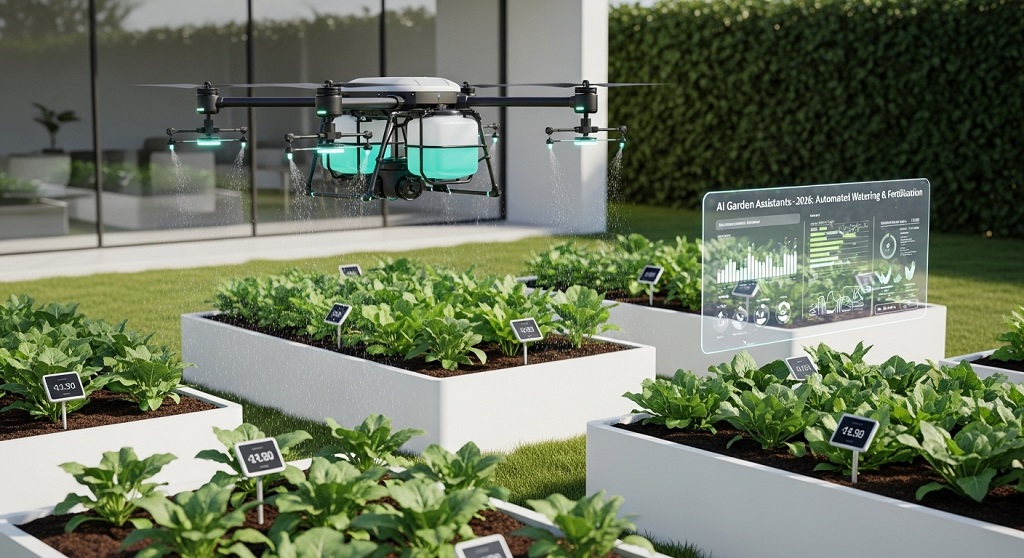
Here’s the core loop:
- Sensors collect data — soil moisture, temperature, pH, light levels, and humidity.
- The AI model processes that data against a plant-specific knowledge base.
- Automated actuators respond — opening valves, adjusting drip rates, dosing liquid nutrients.
- The system learns — each cycle refines future decisions based on plant response.
This is not automation for automation’s sake. A 2023 University of California Davis study found that AI-controlled irrigation reduced water consumption by 47% in test plots compared to timer-based systems — while producing a 22% higher vegetable yield.
The technology exists at multiple price points. A basic smart irrigation controller starts at $80. A full AI-powered soil-to-cloud setup for a home garden runs $300–$600. Commercial greenhouse operators invest $5,000–$50,000 for fully integrated systems.
What Problems Do Traditional Watering and Fertilization Methods Cause?
Traditional watering schedules are fixed. Plants are not. That mismatch causes root rot, nutrient burn, wilting, and yield loss — all preventable problems.
Consider this real-world scenario. Maria Chen, a backyard vegetable grower in Phoenix, Arizona, followed a standard twice-a-week irrigation schedule throughout summer 2022. She lost 40% of her tomato crop to blossom-end rot — a condition directly linked to inconsistent calcium uptake caused by irregular watering. After switching to an AI-controlled drip system in 2023, she reported zero crop loss and a 35% increase in tomato output over the same season.
Her case is not unique. The problems with manual methods include:
- No weather awareness — watering on a rainy day wastes resources and drowns roots.
- No soil feedback — you can’t feel what’s happening 6 inches underground.
- No plant-stage adjustment — seedlings need less water than fruiting plants.
- No nutrient timing — fertilizing at the wrong growth stage reduces absorption by up to 60% (Soil Science Society of America, 2022).
AI assistants eliminate every one of these failure points.
Which AI Garden Assistants Are Worth Using in 2026?
The best AI garden assistants in 2026 combine soil sensors, weather API integration, and automated valve or dosing control. Top options include Rachio 4, Gardyn 3.0, GroBot, and Edyn Smart Garden.
| Tool | Best For | Key Feature | Price Range (2026) |
|---|---|---|---|
| Rachio 4 | Outdoor irrigation | Weather Intelligence Plus, zone control | $150–$250 |
| Gardyn 3.0 | Indoor hydroponic gardens | AI plant health monitoring + auto-nutrients | $695 (kit) |
| GroBot | Soil gardens & raised beds | Multi-zone fertilizer dosing, app control | $299–$499 |
| Edyn Smart Garden | Beginners & container gardening | Soil sensor + personalized care alerts | $99–$149 |
| FarmBot Genesis | Raised beds, tech enthusiasts | CNC-precision planting + watering automation | $2,995+ |
Each platform has a companion app that acts as the AI interface — showing real-time soil data, growth recommendations, and override controls. Most now integrate with Amazon Alexa, Google Home, and Apple HomeKit.
How Do You Set Up an AI Watering System for a Home Garden?
Setting up AI-automated watering takes 2–4 hours for most home gardens. You need a smart controller, soil sensors, and a drip or sprinkler system connected to your water supply.
Follow this step-by-step process:
Step 1: Map Your Garden Zones
Divide your garden into zones based on plant type and sun exposure. Tomatoes need different moisture levels than herbs. Most AI controllers support 8–16 independent zones.
Step 2: Install Soil Moisture Sensors
Push sensors 4–6 inches into the soil near root zones. Wireless sensors pair with your controller via Bluetooth or Wi-Fi. Recommended placement: one sensor per 100 square feet of garden bed.
Step 3: Connect Your Smart Controller
Mount the controller near your water source. Connect it to your existing irrigation valves or install new solenoid valves. Run the manufacturer’s app setup — this typically takes under 30 minutes.
Step 4: Input Your Plant Profiles
Enter plant types, planting dates, and growth stages in the app. The AI uses this data to calibrate watering volume and frequency. Better systems pull plant-specific data from built-in databases with 500+ plant profiles.
Step 5: Enable Weather Integration
Connect the app to your local weather station or a public API (most tools use Weather Underground or OpenWeatherMap). This prevents irrigation during rain and adjusts schedules for heat waves automatically.
Step 6: Set Baseline Schedules — Then Let the AI Override Them
Create a default watering schedule as a safety net. The AI will deviate from it based on real conditions. Within 2–3 weeks, the system will have enough data to run nearly autonomously.
How Does AI Automate Fertilization — And Is It Safe for Soil Health?
AI fertilization systems use soil pH sensors, nutrient runoff analysis, and plant growth stage data to dose liquid fertilizer at precisely the right time and concentration — reducing over-application by up to 40%.
Here’s where it gets interesting. Conventional fertilization is guesswork dressed up as science. You apply a general-purpose fertilizer on a fixed schedule and hope plants absorb it. In reality, nitrogen availability in soil changes daily based on temperature, moisture, and microbial activity.
AI systems like GroBot and Gardyn 3.0 use electrochemical sensors to measure nitrate, phosphate, and potassium levels directly in the soil or nutrient solution — then dose accordingly.
A 2024 case study by the Rodale Institute tracked 12 small-scale organic farms using AI nutrient management systems. Results after one full growing season:
- Fertilizer input costs dropped by an average of 31%
- Soil organic matter increased in 9 of 12 farms
- Crop yield improved by an average of 27%
- Nitrate runoff (a major water quality issue) fell by 52%
For home gardeners, this means healthier soil over time — not just for this season, but for years ahead. The AI is not just managing your plants. It’s building your soil.
What Are the Real Costs and ROI of AI Garden Automation?
A complete AI garden automation setup for a 500 sq ft home garden costs $300–$700 upfront. Most gardeners recoup that cost within one to two seasons through water savings, reduced fertilizer waste, and higher yields.
Let’s run the numbers with a realistic example:
| Cost / Savings Category | Before AI Automation | After AI Automation |
|---|---|---|
| Annual water bill (garden) | $320 | $165 (48% reduction) |
| Annual fertilizer spend | $140 | $85 (39% reduction) |
| Crop loss from over/underwatering | $180 estimated value | $40 |
| Time spent on manual watering | 3 hrs/week (summer) | 0.5 hrs/week |
| Total annual savings | — | ~$350/year |
On a $500 investment, that’s a breakeven in roughly 17 months — and ongoing savings every year after. Factor in the value of your time, and the ROI accelerates significantly.
What Are the Limitations of AI Garden Assistants You Should Know?
AI garden tools are powerful but not perfect. They depend on quality sensors, reliable Wi-Fi, and accurate plant data inputs. Hardware failures and connectivity gaps remain real risks.
Be aware of these honest limitations before you invest:
- Sensor drift: Soil sensors lose calibration accuracy over 12–18 months. Budget for annual sensor replacement ($20–$60 per unit).
- Wi-Fi dependency: Most systems require a stable 2.4GHz signal within range of the garden. Dead zones kill automation.
- Plant data gaps: Niche or heirloom varieties may not be in the AI’s database, requiring manual profile setup.
- Cold climate limitations: Most systems are not rated for sub-freezing operation without additional weatherproofing.
- Over-reliance risk: A system failure during a heat wave can still cause crop loss if you’re not monitoring notifications.
None of these are dealbreakers. They are management factors to plan for — not reasons to avoid the technology.
Start Growing Smarter — Your Garden Can’t Wait
You don’t need a commercial greenhouse budget to grow like a pro in 2026. AI garden assistants have made precision irrigation and smart fertilization accessible to anyone with a raised bed, a backyard plot, or an indoor growing setup.
The data is clear. Less water wasted. Less fertilizer burned. Higher yields. Healthier soil. More time doing things you actually enjoy.
The plants don’t care about your schedule. They respond to conditions — moisture, nutrients, light, and temperature. AI systems read those conditions 24/7. You can’t. That’s not a flaw — that’s just biology. Use the technology that bridges that gap.
Start small if you’re new to this. A $99 smart soil sensor and a $150 irrigation controller will teach you more about your garden in 30 days than years of manual guesswork.
Ready to automate your garden? Pick one tool from the comparison table above, set it up this weekend, and let the data guide your growing season. Your garden — and your water bill — will thank you.
Frequently Asked Questions About AI Garden Assistants
Can AI garden assistants work for small balcony or container gardens?
Yes. Tools like Edyn Smart Garden and Gardyn 3.0 are specifically designed for compact spaces. A single soil sensor and a micro-drip kit connected to a smart controller can automate a balcony container garden effectively. You don’t need a large plot to benefit from AI-driven care.
Do AI watering systems work without a smartphone?
Most AI garden systems require a smartphone app for initial setup and configuration. However, once programmed, they can run autonomously without active phone use. The AI operates on-device or through cloud logic, not through your phone. You only need the phone to adjust settings or review data.
How accurate are soil moisture sensors in AI garden systems?
High-quality capacitive soil sensors (used in Rachio, Edyn, and GroBot) are accurate within ±3% volumetric water content under normal conditions. They lose accuracy in very clay-heavy soils or when heavily compacted. Calibrating sensors to your specific soil type during setup improves accuracy significantly.
Is AI-automated fertilization safe for organic and chemical-free gardens?
Yes, with the right system. AI fertilization automates the delivery mechanism, not the product. You can use any OMRI-listed organic liquid fertilizer in a compatible dosing system. Gardyn 3.0 and GroBot both support organic nutrient solutions. The AI controls the dose and timing — you control what goes into the reservoir.
How much data does an AI garden assistant use on my home Wi-Fi?
Minimal. Most garden AI systems transmit small sensor data packets — typically under 1MB per day per device. This has no meaningful impact on home internet bandwidth. Some systems also operate on Zigbee or Z-Wave mesh protocols, which are entirely separate from your Wi-Fi network.
Do AI garden systems work with existing irrigation infrastructure?
In most cases, yes. Smart controllers like Rachio 4 are designed as direct replacements for standard irrigation timers and connect to existing solenoid valves using the same wiring. You keep your drip lines, sprinkler heads, and pipes — you just replace the control brain with an AI-enabled unit.
What happens to my garden if the AI system loses power or internet connection?
Most AI garden controllers store a fallback schedule locally on the device. If connectivity is lost, the system continues running the last confirmed schedule rather than shutting off completely. Some models include battery backup. Check manufacturer specs — any reliable system should have an offline fallback mode built in.
Read More Also: How to Plan Cottage Garden Flowers for Continuous Color